Start Answering Before They Stop Talking: How We Make a Voice Agent Fast
Drafts on half-finished sentences, speaking while the model is still writing, fillers that tell the truth, and racing the slow tail.

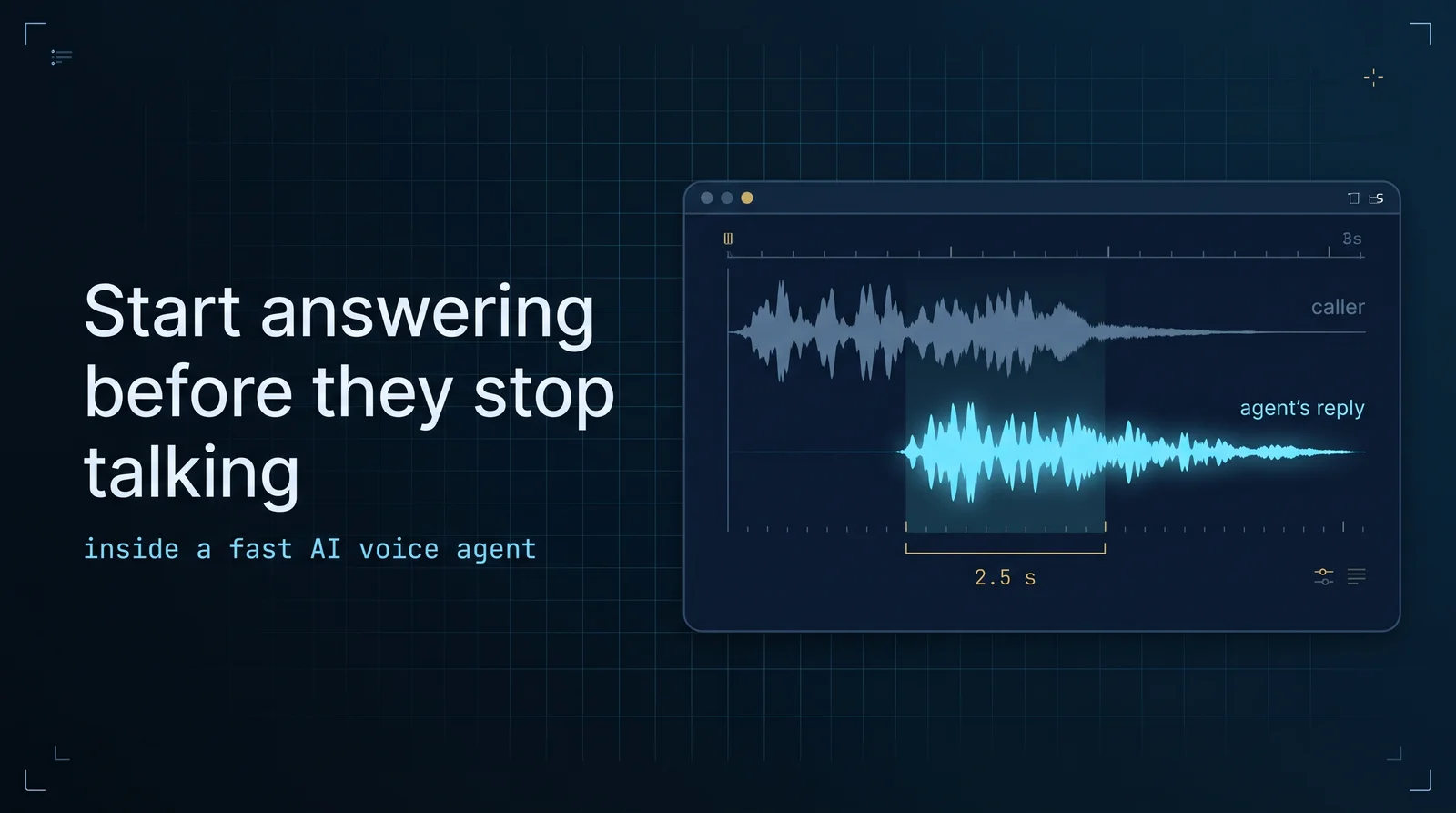
On a text chat, a slow answer is a typing indicator. On a phone call, a slow answer is silence, and silence on a phone sounds like something broke. The caller says "Hello?", talks over you, or hangs up.
Genie's Desk is our phone agent at MagicDoor. Tenants call it about a leaking sink, prospects call it to book a showing. Everything in this post comes from one rule we built it around:
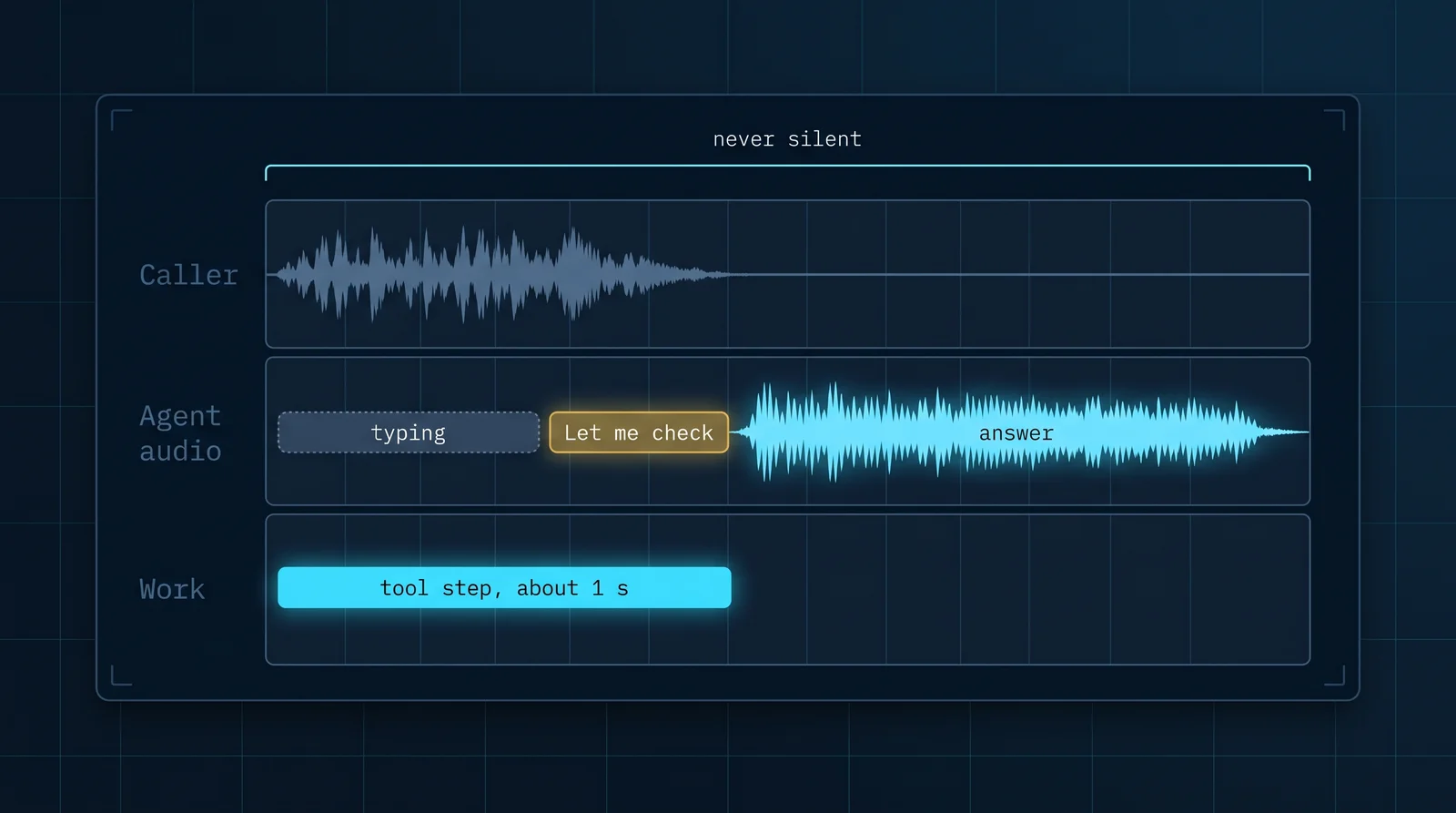
A caller waits at most 2.5 seconds in silence, and at most 6 seconds if they hear typing or a short "let me check".
Our internal timers are tighter than that (1.6 and 5.0 seconds), because a line we send can take up to 0.85 seconds to actually reach the caller's ear. The rest of this post is how we fit a speech recogniser, a language model, tools and a voice into that budget.
The call at a glance
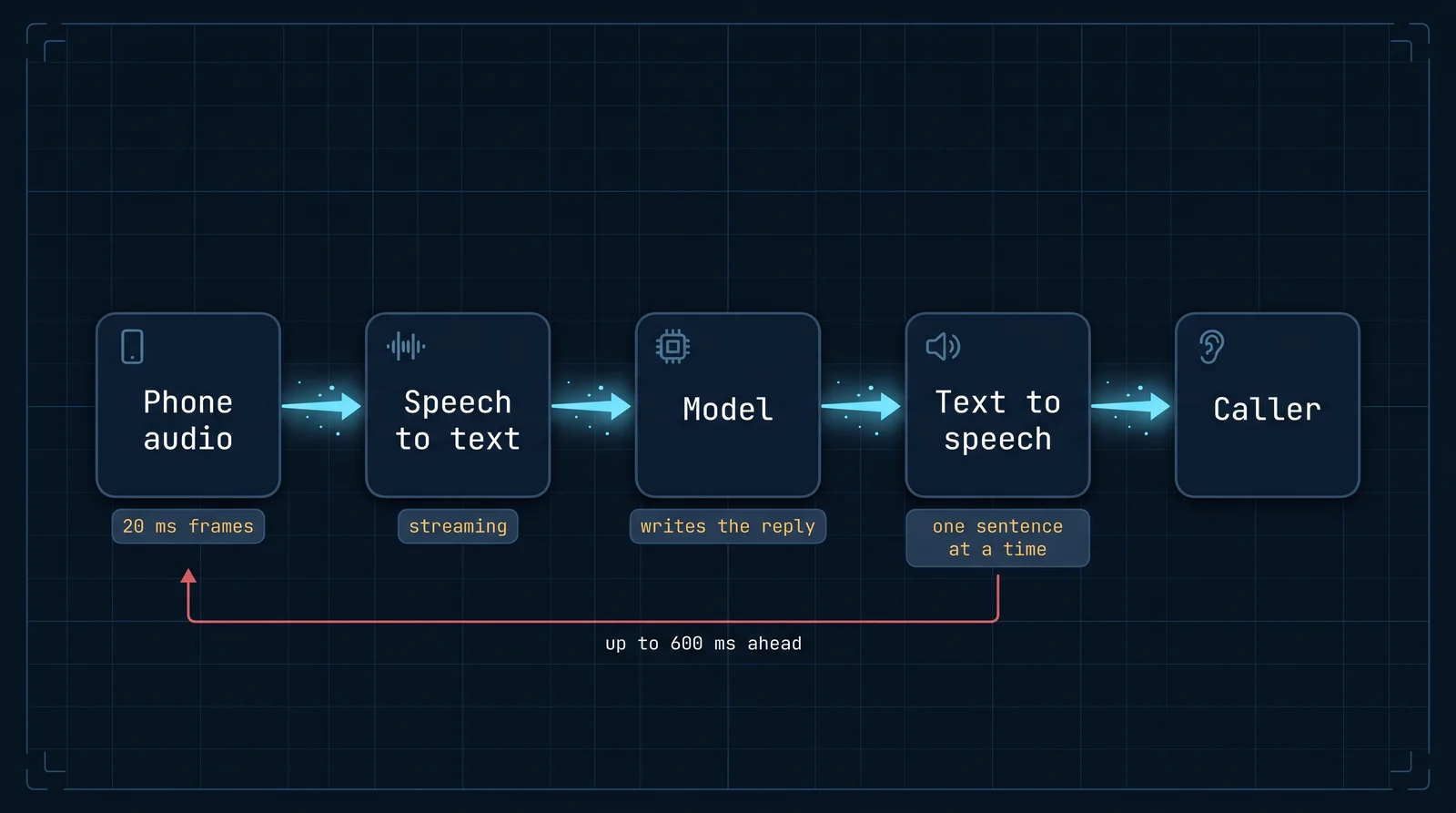
Phone audio arrives in 20 ms frames. A streaming speech recogniser turns it into words as the caller speaks. The model reads the conversation and writes a reply. Each finished sentence goes to a streaming voice, and its audio goes back down the line, up to 600 ms ahead of the call clock so there are no gaps between sentences.
Nothing in that chain waits for the step before it to fully finish. That's the whole game.
Start before they finish: drafts
The slowest moment in a voice turn is right at the start: the caller stops talking, and only then does anyone start thinking about an answer. So we start earlier.
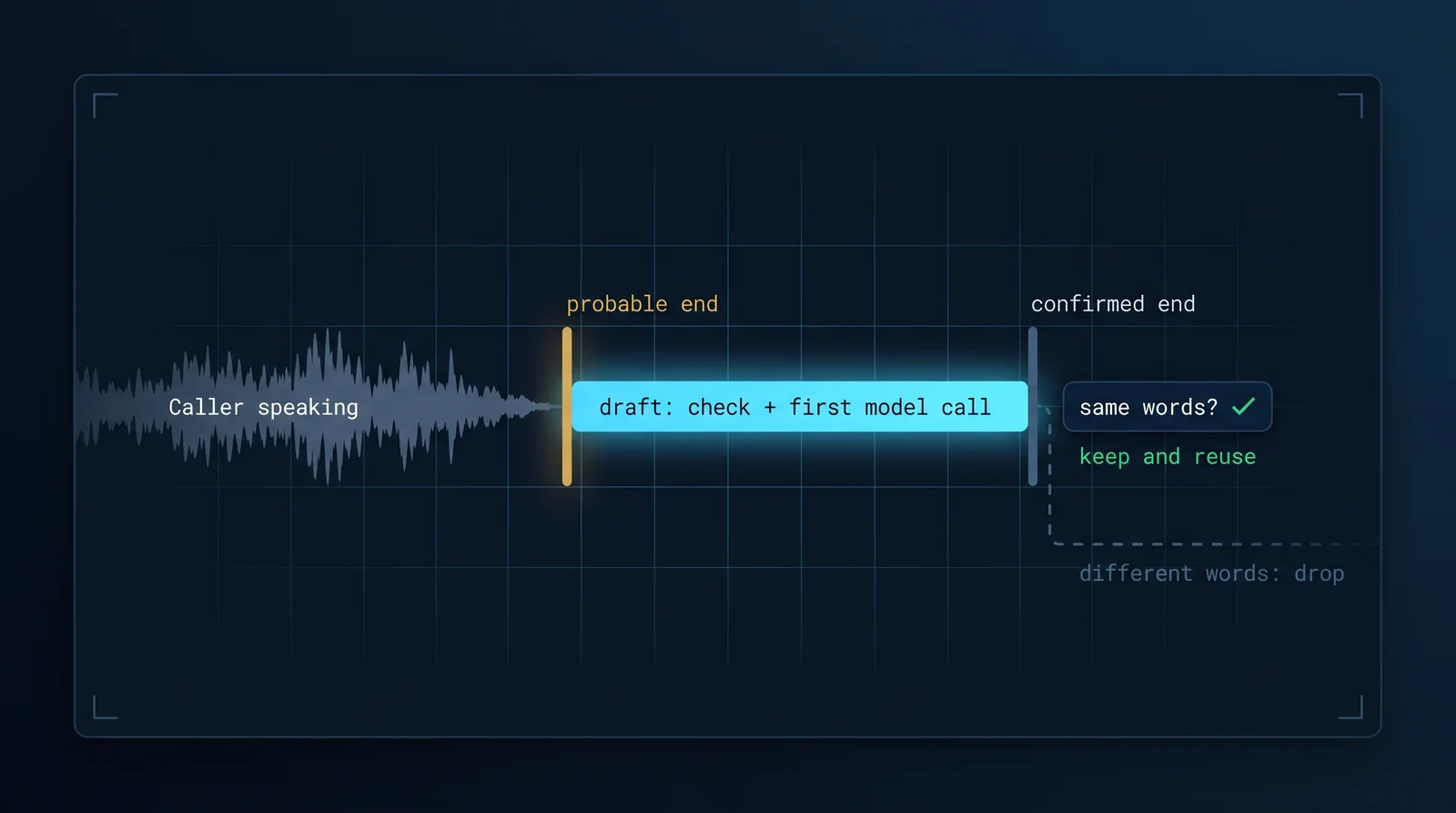
Our speech recogniser sends two signals. One says the caller has probably finished their turn. The other, a moment later, confirms it. At the first signal we start a draft: the safety check on what the caller said, and the first model call, both run on the words so far. Nothing is written, said or run yet. It's a guess.
When the end of the turn is confirmed, we compare the words:
- Same words (ignoring case and punctuation): the draft is kept, and the model call it started is reused.
- Different words, or the caller kept talking: the draft is dropped and we start fresh.
The model call is only reused if the real turn's request is byte-for-byte the same as the draft's: same prompt, same messages, same tools. Anything else is cancelled. A draft can never leak a reply to a question that wasn't quite asked.
A draft only ever does read-only work. Tools, writes and anything with side effects run only in the turn we keep, so a dropped draft costs nothing but the model call.
Speak while the model is still thinking: <say>
This is the trick that changed the most, and it's simple.
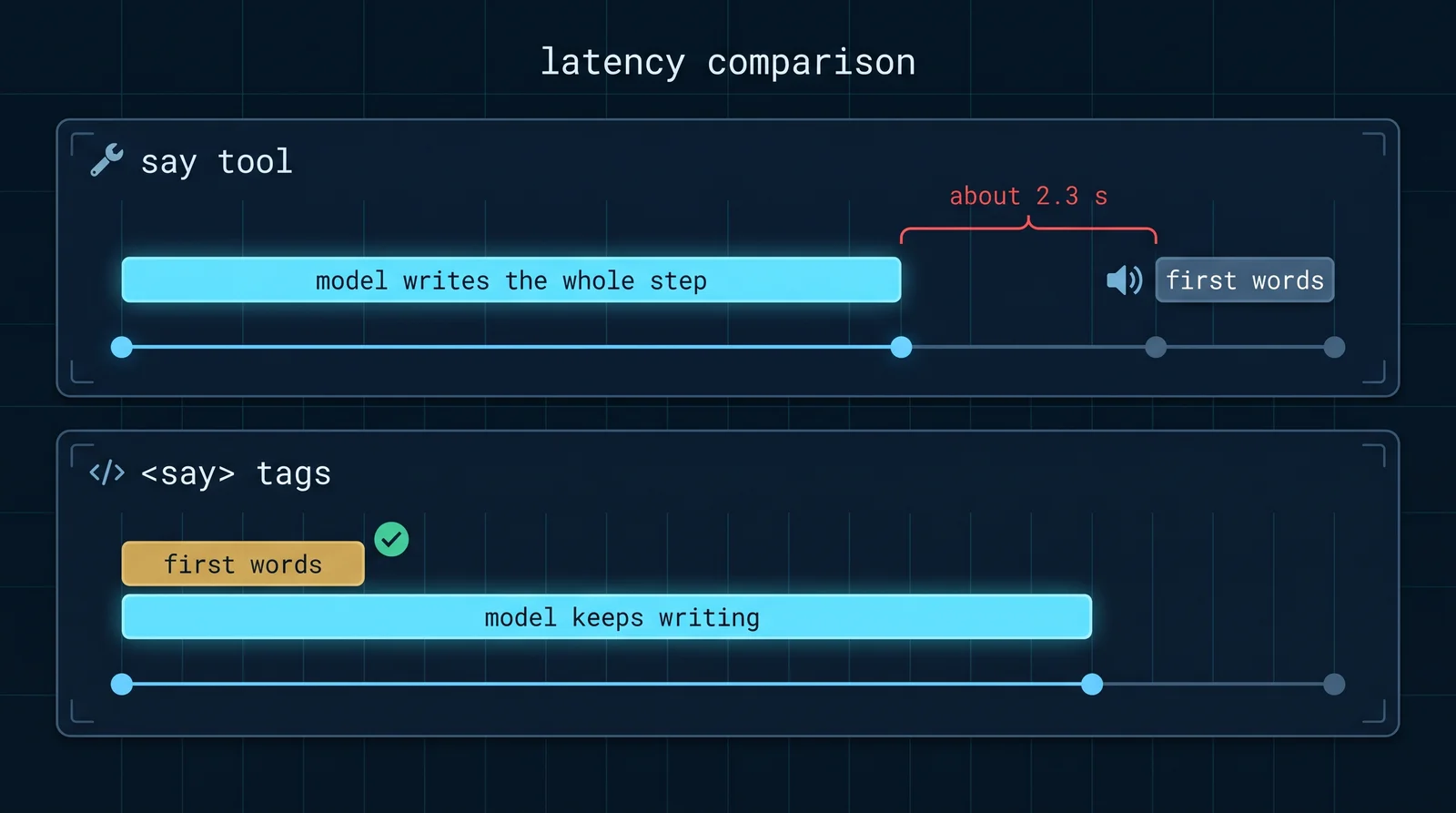
The obvious way to let a model "talk" is a tool: give it a say(text) tool and play whatever it passes. The problem is how tool calls arrive. A tool call is only usable when its arguments are complete, which means the model has to finish its whole step before we can send a single word to the voice. That puts about 2.3 seconds between the caller finishing and the first word they hear.
So the model doesn't call a tool to speak. It writes the words it wants spoken inside <say> tags, in its normal text output:
The caller wants a showing on Saturday. Check the calendar first.
<say>Sure, let me look at Saturday for you.</say>
We read the model's output as it streams. The moment a <say> opens, its words flow to the voice, sentence by sentence, while the model is still writing everything else. The first sentence can be playing before the model has finished deciding what comes next.
The tags do a second job: they separate thinking from speaking. Everything the model writes outside <say> is its thinking. It's stored as thinking and never spoken, never shown as one of Genie's lines in the transcript, and never read back as something Genie said. The model can reason in plain text ("check the calendar first") without that reasoning leaking into the caller's ear.
A few details made it robust:
- Tags can arrive split across streamed chunks; the reader handles a tag broken in half.
- A closing tag ends its sentence at once, so a sentence plays the moment it's finished.
- Markup, internal IDs and stray labels never play, even inside a tag.
- Words come before tools in a step. If a step has words and a tool, the words play first and the tools run after, because a tool may end the call.
One sentence at a time
The voice gets one sentence at a time. A sentence plays as soon as it's finished and has passed our checks, while the model keeps writing the next one. On an open voice connection, the first audio comes back 0.16 to 0.20 seconds after a sentence is sent.
We never cut on a comma, though. A sentence split at a comma is read as two separate sentences and sounds like an odd pause in the middle of a thought. Waiting for the full stop costs about 150 ms, on about one turn in 17. That's a good trade for sounding like a person.
Cover the wait, honestly
Some waits can't be avoided: looking up a lease in the property system, searching the knowledge base. What matters is what the caller hears meanwhile.
Every tool knows how long it usually takes:
- Short (40 to 200 ms): the caller hears a soft typing sound, nothing more.
- Medium (a live property-system call, about 1 second): typing plus a short filler like "Let me check".
- Long (a search, 1.2 to 3 seconds): the same, at the start of the step.
If a wait runs long, "still checking" plays at 5 seconds, and a slow property system gets its own line at 3.5 seconds.
One rule keeps fillers from sounding broken: a filler that has started is never cut off. Its first 600 ms are already on the line and can't be taken back, so cutting it would only leave half a word.
Load once, not every turn
A text chat can afford to look things up turn by turn. A phone call can't.
When a call is connected, we build its context once: who's calling, their home, their open maintenance requests, the whole policy handbook and the newest knowledge entries. There's no model call and no search in that step. Searching later in the call is a tool the model uses when it needs it.
The read from the property system runs while the greeting plays, which gives it several seconds before the caller says a word (a turn waits for it at most 3 seconds). And the prepared context sits right behind the system prompt with a cache marker on it, so every turn of the call reuses it from the cache. I wrote about why that ordering matters in just-in-time context.
Warm everything up
Cold starts hide in odd places:
- The model connection. During the greeting we send a one-token request to the model that runs the first check of every turn, so the first real turn doesn't pay for a cold connection.
- The voices. A voice's first sentence on a fresh server takes seconds; after that, about a quarter of a second. So the voices are warmed when a server starts, never while a caller is waiting.
- Fixed lines. The greeting, goodbyes and fillers are recorded once and replayed. Generating them live costs about 100 ms more each time.
Race the slow tail
Median latency is what you measure. The slow tail is what callers remember: a single hung request can mean twenty seconds of silence.
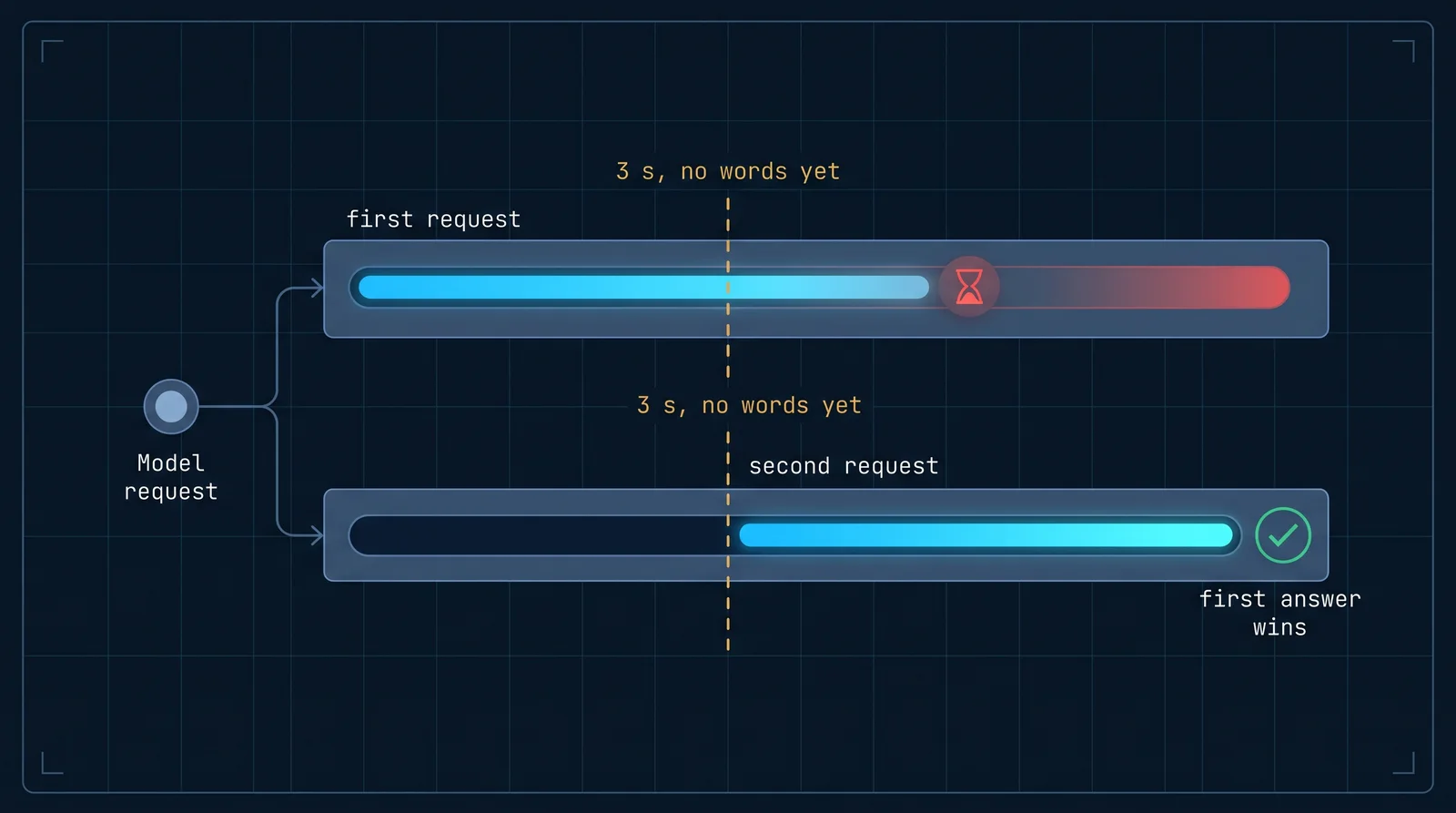
So for the requests that matter, we send a second identical one if the first is slow, and use whichever answers first:
- The reply model: if no word has arrived after 3 seconds, we send the request again. The median first word arrives at 0.74 seconds, and 215 of 222 requests had one by 2.93 seconds, so 3 seconds only catches the stragglers.
- The safety check: resent after 0.9 seconds. Its median is 0.66 seconds, but it can take up to 3.4.
Two more things shave the tail. Read-only tools in the same step run in parallel, and a step that's only lookups runs alongside the safety check instead of after it. And when a model is available from several hosting providers, we order them by measured response time.
Persona switching without dead air
Genie's Desk runs on the harness I reach for whenever speed comes first: persona switching. There's one conversation and one session. When the topic calls for it, a specialist persona such as Maintenance or Showing claims the call, and releases it back to the main agent when it's done. The caller hears one continuous conversation, and nothing has to be re-explained, because every persona sees the whole call.
On a phone call, the switch itself still has a cost. The new persona's first line needs a model call, 1.5 to 1.8 seconds, so a switch is treated like a medium tool step and typing and a short filler cover it. Nothing is said at the moment of the switch, so no "one moment" collides with the new persona's first words.
The incoming persona also gets a note of the tool calls already made in the turn, so it never repeats a lookup or a save that was just done.
Interruptions and endings
People interrupt. The moment we hear the caller start talking, we pause the audio instantly but keep what we were going to say, then decide at the end of their turn. If it was a cough or a "mm-hm", we resume from the start of the sentence we cut. After three false stops in a call, a sound alone no longer pauses us.
Endings need care too. We wait 1.5 seconds after the last words before hanging up, because audio that has left our side can still be on its way to the caller, and the last words of a call are often the important ones.
Measure every turn
Every number in this post comes from the same place. Each turn records timing marks, measured from the moment the caller's turn ended: the early end-of-turn signal, draft kept or dropped, the model's first word, the first audio sent, filler queued, typing started. A small script prints a call's timeline, and our operator portal shows the latency of every turn.
You can't tune what you can't see, and with voice, the problems are always in the tail.
A checklist for your own voice agent
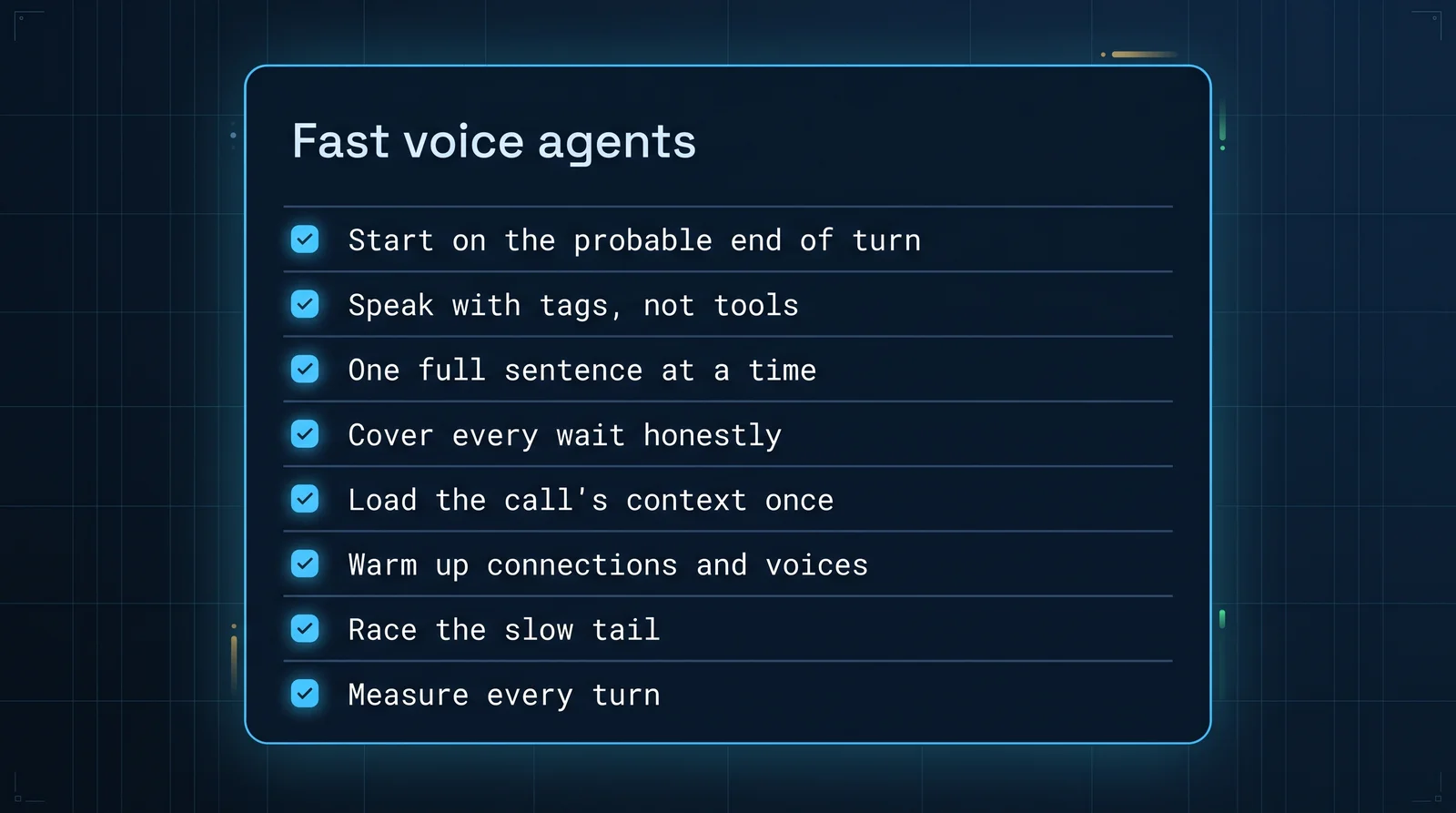
- Start on the probable end of turn, and keep the draft only if the words match.
- Let the model speak through tags in its text, not a tool, so speech starts while it's still writing.
- Send speech one full sentence at a time.
- Cover every wait with something honest, and never cut a filler off.
- Load the call's context once, and put it under the prompt cache.
- Warm up connections and voices before anyone is waiting.
- Race the slow tail with a second request.
- Measure every turn from the moment the caller stopped talking.
Closing
None of these tricks is clever on its own. Together they're the difference between a phone agent that feels like a person thinking and one that feels like a machine loading. Start before they finish, speak while you think, and never leave anyone in silence.